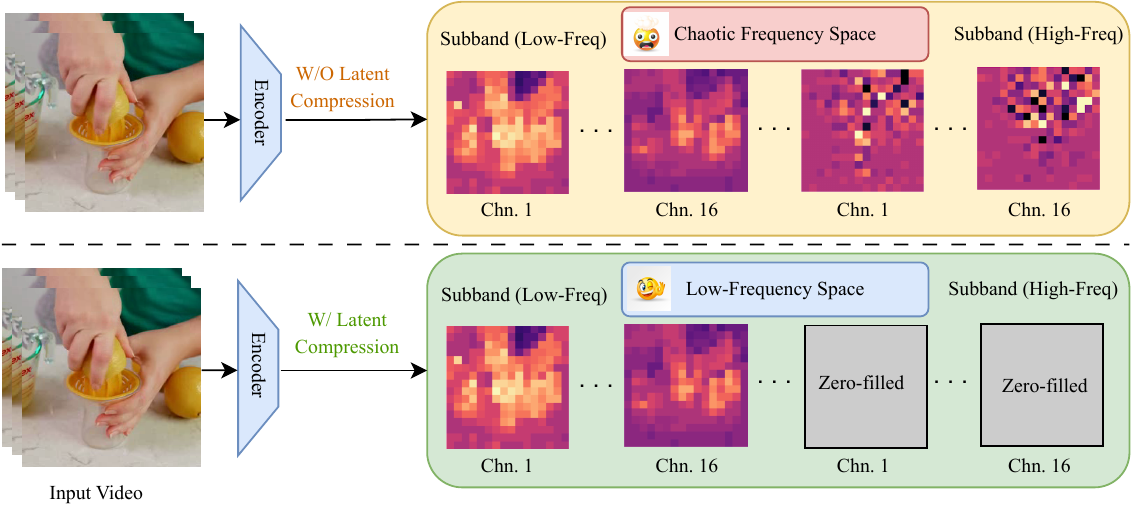
Figure 1. Comparison between video VAEs with and without the proposed latent compression. LC-VAE performs frequency-aware latent compression for video generation. An input video is encoded and decomposed by multi-level 3D wavelet transforms (Multi-WT); low-frequency channels are retained as compact latent representations where diffusion operates. After denoising, the latent is zero-padded, processed by multi-level inverse wavelet transforms (Multi-IWT), and decoded into the final video. This design preserves global structure while reducing latent dimensionality.
Abstract
Compressing Latent Space by Removing Uninformative High-Frequency Components
Video variational autoencoders (VAEs) used in latent diffusion models typically require a sufficiently large number of latent channels to ensure high-quality video reconstruction. However, recent studies have revealed that an excessive number of latent channels can impede the convergence of latent diffusion models and deteriorate their generative performance, even when reconstruction quality remains high. We propose a latent compression method that removes high-frequency components in video latent representations rather than directly reducing the number of channels, which often compromises reconstruction fidelity. Experimental results demonstrate that the proposed method achieves superior video reconstruction quality compared to strong baselines while maintaining the same overall compression ratio.
Method
LC-VAE: Frequency-Aware Latent Compression
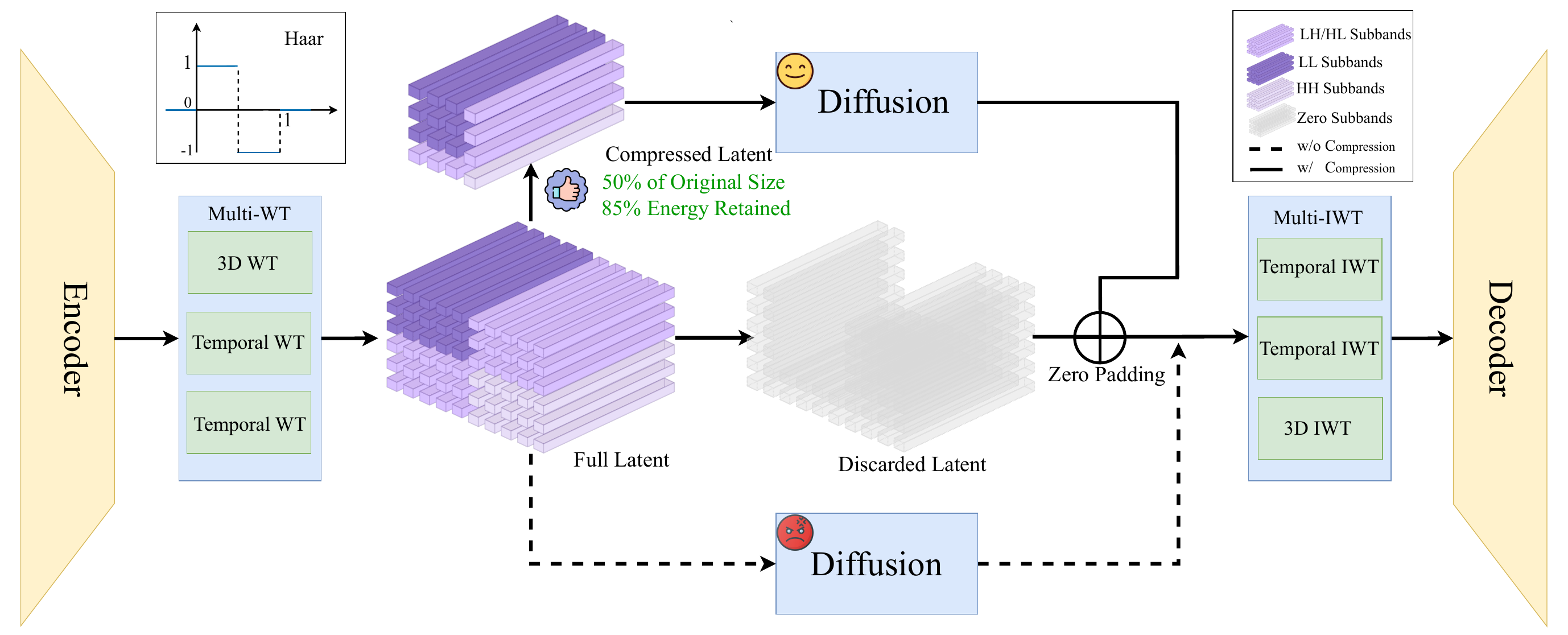
LC-VAE compresses the video latent by applying a multi-level 3D Haar wavelet transform and selectively zeroing out the high-frequency subbands. The encoder is forced to focus on diffusion-favorable, low-frequency content — high-frequency texture recovery is delegated to the decoder.
Figure 2. Overview of the LC-VAE framework. The model first applies a multi-level wavelet transform (Multi-WT) to the latent features produced by the encoder. Low-frequency channels are selected to retain compact yet informative representations, while the high-frequency subbands are zeroed out. During generation, diffusion operates within this compressed subspace. The sampled representation is subsequently zero-padded, passed through multi-scale inverse wavelet transforms (Multi-IWT), and decoded to reconstruct the video.
Wavelet Subband Selection — 3D Haar Decomposition
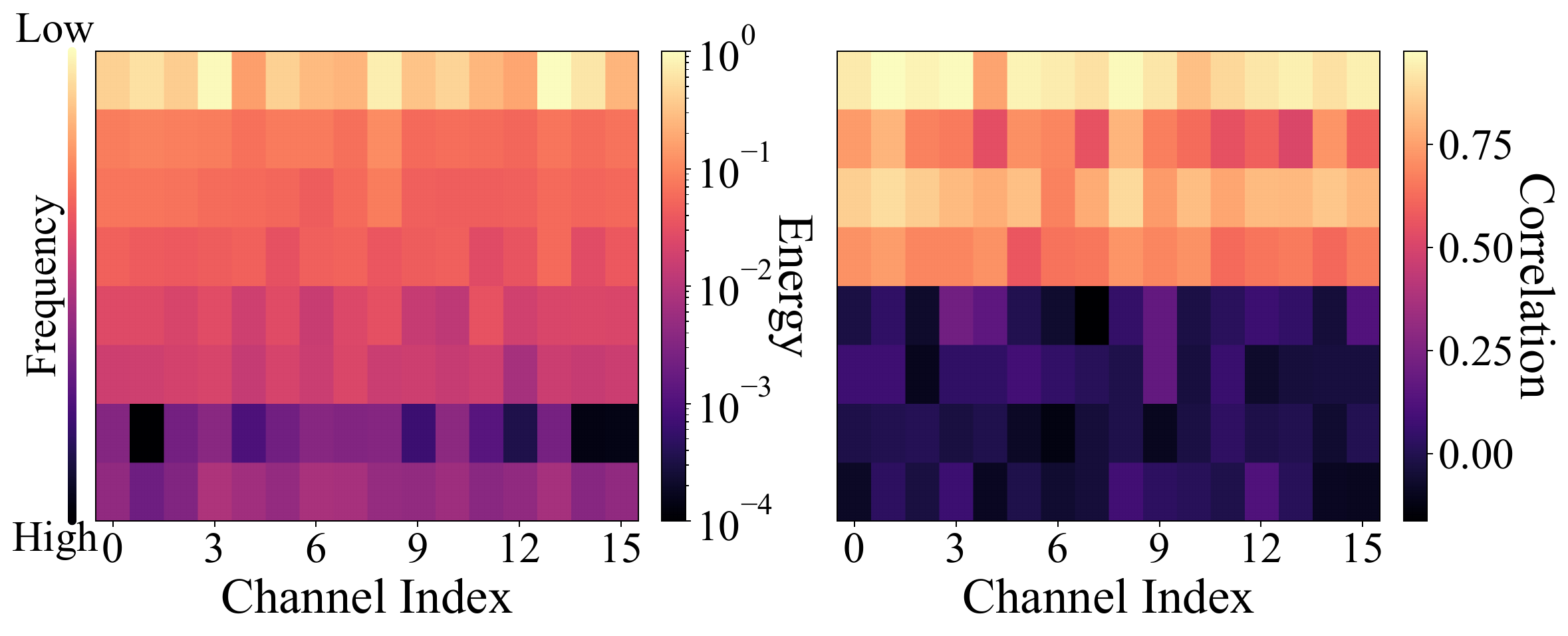
Figure 3. Energy and correlation distribution across frequencies. Low-frequency subbands exhibit higher energy and stronger temporal correlation, whereas high-frequency subbands are less informative.
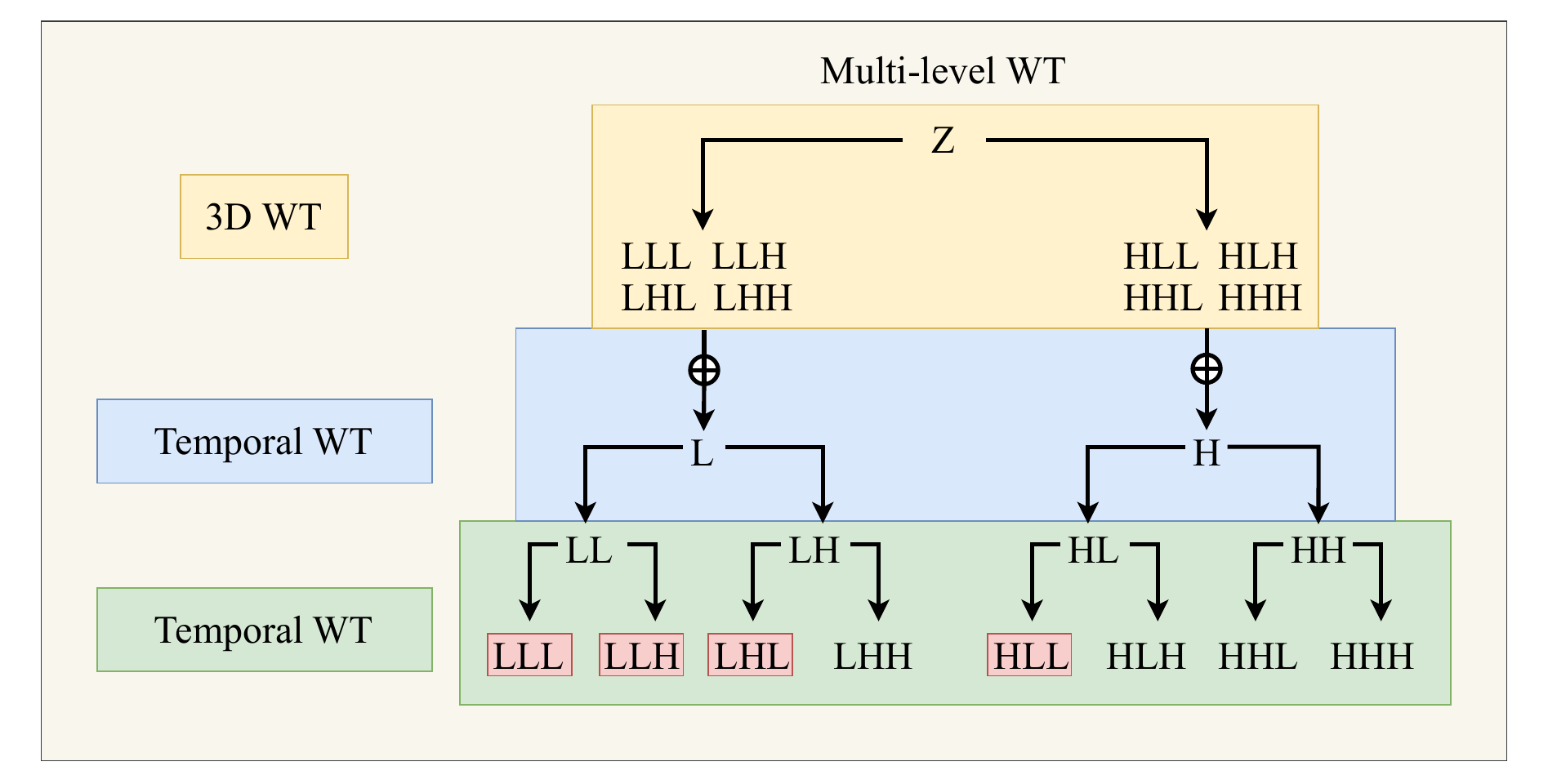
Multi-level WT. Hierarchical 3D Haar wavelet decomposition producing 8 subbands per level — {LLL, LLH, LHL, HLL} are retained; {LHH, HLH, HHL, HHH} are zeroed out.
1Latent-space wavelet analysis. We apply a 3D Haar wavelet transform to video latent representations and show that low-frequency subbands dominate energy and temporal autocorrelation, while high-frequency subbands are disordered and contribute little to reconstruction quality.
2Frequency-aware latent compression. By zeroing out the four highest-frequency subbands (LHH, HLH, HHL, HHH) and retaining only {LLL, LLH, LHL, HLL}, LC-VAE achieves a compact, diffusion-friendly latent without reducing the number of channels — which would sacrifice reconstruction fidelity.
3Architecture-agnostic design. Our compression and reconstruction procedure is a drop-in module compatible with existing video VAE architectures and training objectives (L1, LPIPS, adversarial, KL, wavelet-flow losses).
4Downstream generation benefits. Diffusion models trained on LC-VAE's compact, low-frequency latents exhibit superior generation performance compared to those trained on baseline representations.
Experiments
State-of-the-Art Video Reconstruction
We evaluate LC-VAE against six strong baseline video VAEs across multiple large-scale benchmarks. Experiments cover video reconstruction quality, zero-shot generalization, and diffusion-based generation capability.
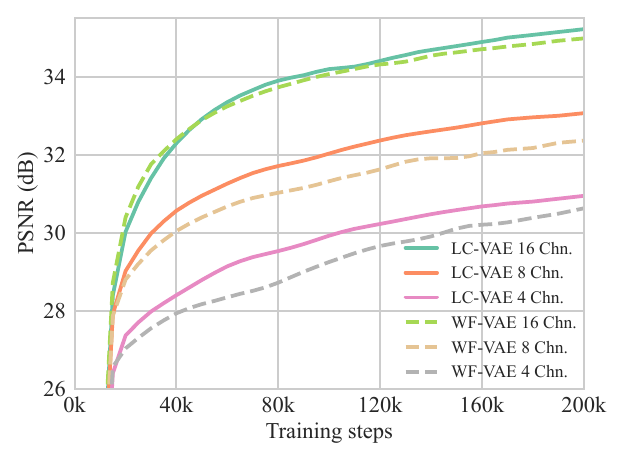
Figure 5 — Validation PSNR during training. Across all channel sizes (Chn. = 4, 8, 16), LC-VAE consistently achieves higher validation PSNR than WF-VAE throughout training, demonstrating faster convergence and better reconstruction quality.
Table 1 — Main Reconstruction Performance
Zero-shot test on WebVid-10M and Panda-70M. TCPR = token compression ratio; Chn. = latent channels. Bold = best.
Method
TCPR
Chn.
WebVid-10M
Panda-70M
PSNR ↑
SSIM ↑
LPIPS ↓
rFVD ↓
PSNR ↑
SSIM ↑
LPIPS ↓
rFVD ↓
SD-VAE
64×
4
30.19
0.838
0.057
284.9
30.46
0.890
0.040
183.0
SVD-VAE
64×
4
31.18
0.869
0.055
188.7
31.04
0.906
0.038
137.7
CV-VAE
256×
4
30.76
0.857
0.080
369.2
30.18
0.880
0.067
296.3
OD-VAE
256×
4
30.69
0.864
0.055
255.9
30.31
0.894
0.044
191.2
Open-Sora VAE
256×
4
31.52
0.876
0.056
208.5
31.21
0.910
0.040
155.6
WF-VAE
256×
16
33.62
0.912
0.036
96.2
33.11
0.938
0.026
76.4
LC-VAE (Ours)
256×
16
34.41
0.921
0.031
74.8
34.07
0.944
0.022
58.3
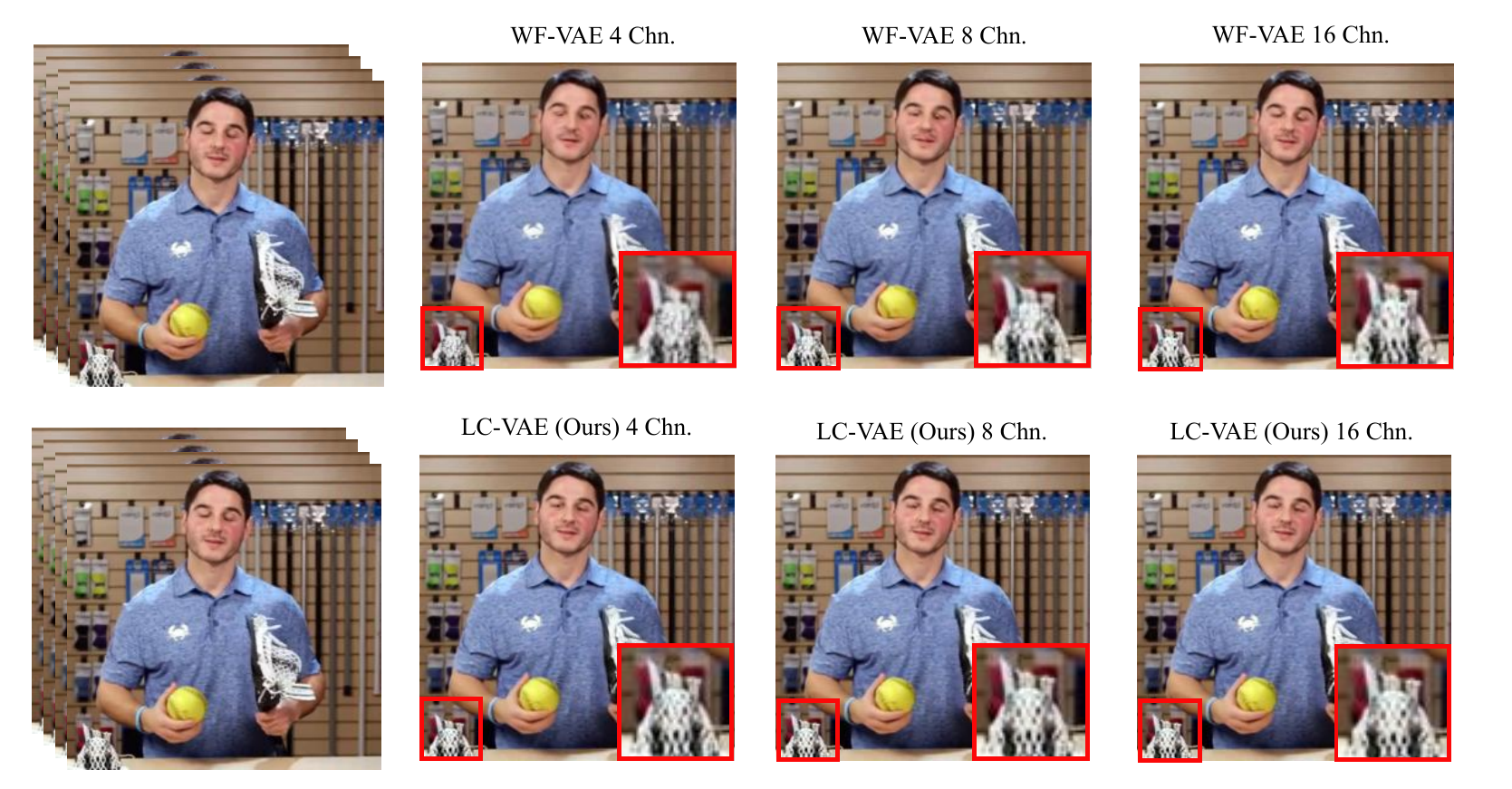
Figure 4 — Qualitative comparison of reconstruction performance. LC-VAE vs. WF-VAE under the same compression ratios (equivalent channels). LC-VAE reconstructs finer details with fewer artifacts across diverse scenes.
Table 2 — Zero-Shot Generalization
Reconstruction on three unseen datasets. LC-VAE maintains consistently high performance while WF-VAE suffers a 0.5–1.5 dB PSNR drop on out-of-domain data.
Method
Chn.
UCF-101
SkyTimelapse
OpenVid-1M
PSNR ↑
SSIM ↑
LPIPS ↓
rFVD ↓
PSNR ↑
SSIM ↑
LPIPS ↓
rFVD ↓
PSNR ↑
SSIM ↑
LPIPS ↓
rFVD ↓
WF-VAE
4
30.32
0.896
0.043
337.7
36.59
0.944
0.020
100.7
32.98
0.883
0.042
193.1
LC-VAE (Ours)
4
30.57
0.901
0.033
340.2
36.87
0.949
0.015
87.1
33.48
0.899
0.024
145.0
WF-VAE
8
31.86
0.920
0.029
189.5
37.71
0.954
0.014
61.7
34.20
0.907
0.031
109.9
LC-VAE (Ours)
8
32.69
0.929
0.023
198.9
38.65
0.962
0.010
50.4
35.27
0.925
0.017
89.4
WF-VAE
16
34.40
0.949
0.017
81.3
39.85
0.968
0.008
28.1
36.28
0.933
0.017
51.0
LC-VAE (Ours)
16
34.83
0.951
0.016
106.1
40.30
0.972
0.008
27.3
37.06
0.946
0.012
50.4
Table 3 — Video Generation Quality (Latte Diffusion)
FVD₁₆ and IS evaluated on SkyTimelapse (unconditional) and UCF-101 (class-conditional) using Latte-L trained for 200k steps.
Method
Chn.
SkyTimelapse
UCF-101
FVD₁₆ ↓
FVD₁₆ ↓
IS ↑
WF-VAE
4
198.87
565.80
61.19
LC-VAE (Ours)
4
240.56
509.76
70.71
WF-VAE
8
213.23
687.60
60.57
LC-VAE (Ours)
8
201.24
654.96
66.72
WF-VAE
16
195.94
721.43
52.66
LC-VAE (Ours)
16
187.68
735.04
54.89
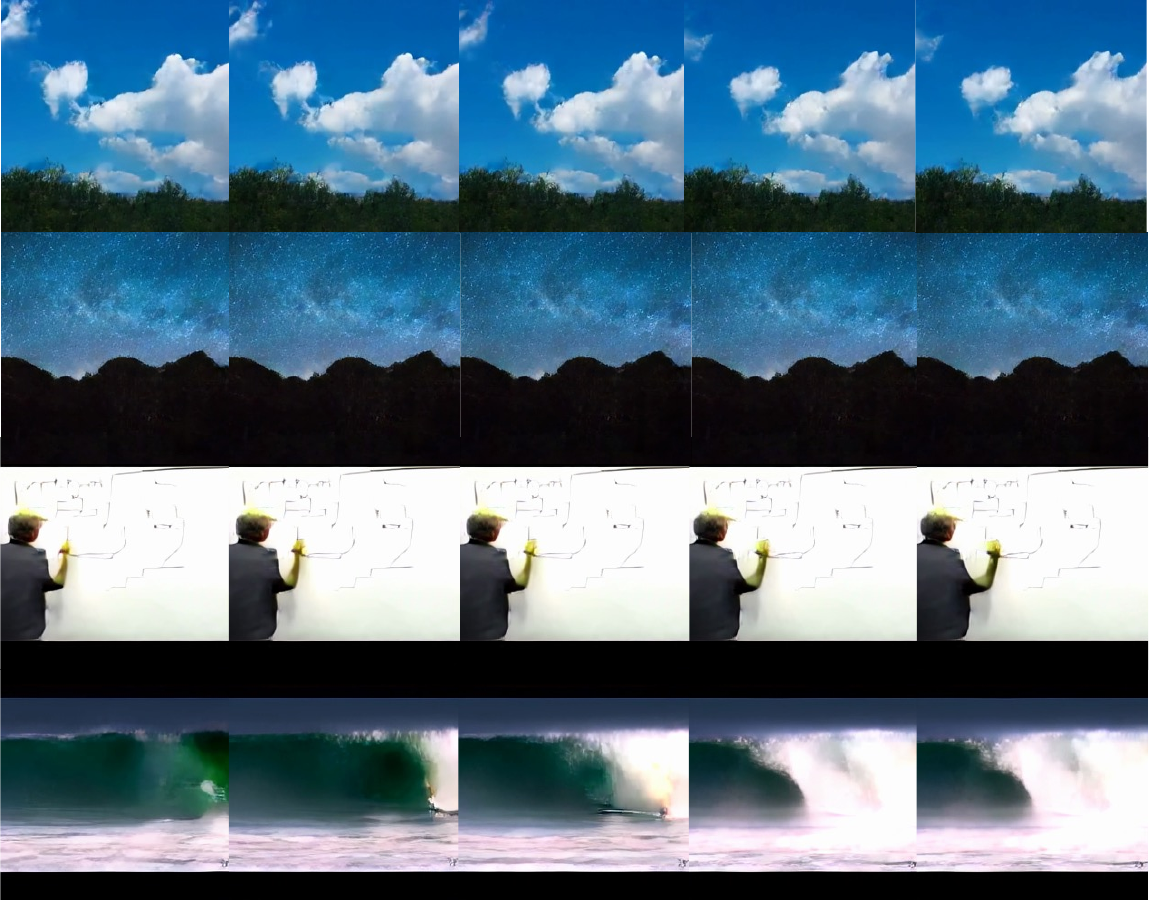
Figure 6 — Generated videos using LC-VAE with Latte. SkyTimelapse (top) and UCF-101 (bottom) datasets. LC-VAE's compact low-frequency latent enables more coherent and higher-quality generation across diverse video categories.
Table 4 — Ablation: Joint Training vs. Post-Training Compression
Comparing LC-VAE against post-training latent compression (PTLC) applied to a pre-trained WF-VAE. Results confirm that joint training with latent compression is essential — PTLC degrades reconstruction by up to 5 dB PSNR.
Method
Chn.
WebVid-10M
Panda-70M
PSNR ↑
SSIM ↑
LPIPS ↓
PSNR ↑
SSIM ↑
LPIPS ↓
WF-VAE (PTLC)
8
29.24
0.839
0.068
27.51
0.853
0.078
LC-VAE (Ours)
8
31.49
0.921
0.025
31.89
0.891
0.030
WF-VAE (PTLC)
16
30.49
0.873
0.055
28.67
0.874
0.068
LC-VAE (Ours)
16
33.78
0.921
0.021
33.64
0.945
0.017
Citation
BibTeX
If you find LC-VAE useful in your research, please consider citing our paper:
@inproceedings{guan2026lcvae, title = {Latent-Compressed Variational Autoencoder for Video Diffusion Models}, author = {Guan, Jiarui and Zhao, Wenshuai and Zou, Zhengtao and Kannala, Juho and Solin, Arno}, booktitle = {Proceedings of the IEEE/CVF Conference on Computer Vision and Pattern Recognition Findings (CVPRF)}, year = {2026},
}